A Look at Mesothelioma Insurance Claims


In the United States and much of the world, asbestos was used very heavily in most aspects of construction. It was also used in a wide variety of consumer, commercial and industrial products. The reason it was so prevalent was because it’s a cheap, naturally-occurring substance that has a remarkable ability to resist heat, fire, caustic chemicals and electricity.

However, in addition to all of these helpful properties, it also causes cancer. These days, most people are aware that exposure to asbestos causes malignant mesothelioma, but this was a closely guarded secret for much of the last century. Those in asbestos industry were well aware of the dangers of asbestos, but since they also knew it would take between 20 and 50 years for people to get sick, they were willing to take that chance and pay later if necessary. 

When they eventually had to pay up, it caused a lot of companies to go bankrupt. However, not all of the damages were paid by the companies that produced asbestos. Many had what are now known as “historic policies.” According to a recent news article from the Financial Times, these claims are now costing the insurance industry $15 billion more than had initially been projected.

The reason for this, as our Boston mesothelioma attorneys can explain, is because thousands of people are still getting diagnosed with mesothelioma each year, and many of those people are dying. While the insurance companies had hoped the partial ban on asbestos would result in a slowdown of the number of victims being diagnosed each year, that does not appear to be the case.

Since insurance companies make money by selling policies and trying to pay out less in claims than they earn in revenue, it is not hard to imagine how they are tired of paying out claims when people develop malignant mesothelioma. According to one recent study, the insurance companies have already paid out nearly $65 billion, and that number is still rising to about $100 billion, which is the new estimate.

One the reasons they were wrong on the estimates is because they were only making calculations based upon the number of workers they estimated were exposed to asbestos. What they failed to account for was children of those workers who were exposed through their parents and other relatives who came home from work each night still covered in the deadly asbestos fibers. This type of exposure to asbestos is called “take home” exposure in mesothelioma lawsuits.

In addition to this emerging class of mesothelioma claimants, there are also all of the people who are currently residing in structures that are filled with asbestos and are in a crumbling and dilapidated state. It is a sad reality that many of these people will one day develop the deadly form of cancer. For these reasons, it appears that it will be a very long time before we are no longer seeing victims of asbestos exposure.

Mesothelioma and asbestos

Mesothelioma is a rare and aggressive form of cancer which kills around 2,400 people in the UK each year. It is usually caused by exposure to asbestos, which often occurs in the workplace. Insurers pay out £200 million a year to mesothelioma sufferers.

Asbestos is a material that was commonly used in the manufacturing and construction industries between the 1950s and the 1980s. People who worked in these industries during this time were regularly exposed to asbestos, inhaling asbestos dust and fibres over a prolonged period of time. It later emerged that the inhalation of asbestos was the main cause of mesothelioma.

Mesothelioma is a cancer which affects the lungs or the lining of the stomach. It is almost always fatal, with most sufferers dying within two years of diagnosis. There is currently no known cure for mesothelioma – treatment usually focuses on relieving a sufferer’s symptoms and improving their quality of life.

Mesothelioma sufferers can make compensation claims against the employer for whom they were working at the time they were exposed to asbestos. Mesothelioma has a long latency period – that is the time between a person’s initial exposure to asbestos and the development of the disease – usually between 30 and 40 years. This can mean that the employer in question no longer exists. In such cases, the mesothelioma sufferer can submit a claim to their former employer's employers' liability insurer. 

The insurance industry is committed to helping people with mesothelioma and their families to get the support they need. The ABI is campaigning to reform the compensation process for mesothelioma sufferers. We are working with the Government and insurers to make the compensation process quicker and easier for mesothelioma sufferers through measures including:
Supporting medical research

Insurers have donated over £3 million over the last three years to the British Lung Foundation (BLF)’s research into a cure for mesothelioma. 
Raising awareness of asbestos exposure at work and in the home

Insurers have funded the BLF’s ‘Take five and stay alive’ campaign which raises awareness of dangers of asbestos exposure among those most at risk for example, DIY enthusiasts and tradespeople such as plumbers and electricians.
Reforming the legal system

The legal process for mesothelioma claims can be complex, lengthy and expensive. The insurance industry is campaigning for improved processes that will allow mesothelioma sufferers to settle their cases more quickly.
Tracing insurers and former employers

Mesothelioma sufferers may find it difficult to track down their former employer’s employers' liability insurer if the company has gone out of business. In April 2011 the insurance industry set up the Employers’ Liability Tracing Office (ELTO) to help people find insurers if their former employer is no longer in business. The ELTO has a database of millions of insurance policies from all past and present employers' liability insurers. The service has made tracing policies considerably easier for mesothelioma sufferers.

Over the next few month the ABI and the ELTO will be introducing further improvements .These will include a committee to analyse claimants' evidence of the existence of their former employer's employers' liability policy in the absence of the policy itself.
Mesothelioma Support Scheme

In January 2014 the Government passed the Mesothelioma Act 2014legislation to establish the Diffuse Mesothelioma Payment Scheme (DMPS). The scheme is funded by the insurance industry and will make payments to around 3,000 mesothelioma sufferers who cannot find an employer or insurer to claim from. Mesothelioma sufferers diagnosed after 25 July 2012 who are unable to trace an insurer or compensator are eligible to make a claim under the scheme. The first payments will be made in July 2014. A levy imposed on employers' liability insurers will fund the scheme at an estimated cost of £35 million a year. For more information see the DMPS website
Next steps
if you have been diagnosed with mesothelioma speak to a claimant lawyer about making a claim against your former employer
if your former employer has gone out of business, you may be able to track down their insurer through the Employers’ Liability Tracing Office (ELTO
go to the DMPS website for further information

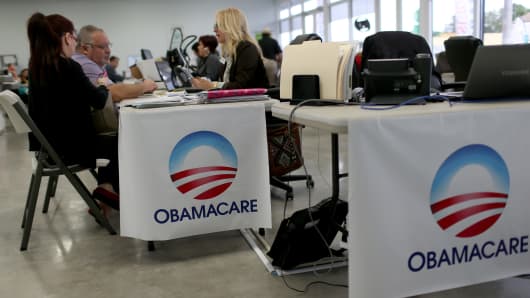
Obamacare insurer expands, but big questions loom as rate deadline hits, GOP pushes health plan

A couple enrolls in Obamacare with an insurance agent in Atlanta.

While Republicans in the Senate are getting ready to unveil their health reform bill, insurers on the Obamacare exchanges have been revealing their plans for next year ahead of Wednesday's deadline to file initial 2018 rate requests.

"This may be the most closely watched rate filing since the first year of the ACA marketplaces," said Katherine Hempstead, a senior advisor at the Robert Wood Johnson Foundation. "They are rightly seen as important signals about the viability of the individual market in its current form."

Four-year-old health insurance start-up Oscar Health has decided that the Obamacare markets are still viable, and is planning to expand coverage next year.

"We are spending 98 percent of our days thinking about 'what does the product look like? What network can we build?'… and 2 percent worrying about the regulatory framework," Oscar Health CEO Mario Schlosser said.

Oscar is planning on launching in two new states next year, announcing Wednesday morning that it will offer coverage in the greater Nashville area in Tennessee, in addition to its new joint venture to offer a plan with the Cleveland Clinic in northeast Ohio.

But Oscar's expansion won't extend to some of Ohio's potentially bare counties, in the southeastern part of the state, where Anthem's decision to withdraw from the state's Obamacare exchange next year could leave some markets with no insurer.

"We've really got to make sure that our unique strategy around how we build networks … also works," said Schlosser.

Centene announced that it would be expanding coverage into Ohio and Missouri, but a spokeswoman for the insurer said it is still working out which parts of those states it will cover

As of Wednesday's deadline, roughly two dozen counties in northwest Missouri had no insurers filing to provide 2018 coverage, according to an analysis by researchers at the Kaiser Family Foundation.

"It is entirely possible that Centene or other insurers could move into some counties that appear to be at risk of having no insurer," said Cynthia Cox, the foundation's associate director. "Consumers in these counties shouldn't worry too much yet, as there is still time for insurers to change their service areas. Companies don't get locked in until early fall."

In Washington state, two counties had been facing no insurer coverage, but earlier this week Premera Blue Cross reportedly reversed course, and agreed to remain in one of those counties, Grays Harbor

"I really feel for a number of our insurance companies, because it's not that they don't want to be participating," said Michael Marchand, chief marketing officer of the Washington Health Benefit Exchange. "It's the uncertainty in the marketplace."

Insurers in the state are asking for a 22 percent increase for next year on average. States insurance officials say the carriers are trying to price in risk that they may not be reimbursed by the Trump administration for cost-sharing reduction subsidies that lower out-of-pocket costs for lower-income enrollees.

"As a result, we're seeing an increase in premiums because it's essentially the insurance companies hedging their bets that there may be the potential for them to have to pick up that CSR costs," said Marchand, referring to the subsidies.

For state regulators and insurers, the question of funding for the subsidies will be a key issue that will hang over rate reviews and the final push toward open enrollment just over four months from now.

"If a way is not found to pay them for 2018 there will losers, but no winners," said Hempstead. "The biggest losers will once again be the unsubsidized customers, who will be exposed to the entire premium increase with no relief."

For that reason Oscar's Schlosser is convinced the Trump administration and Republicans will find a way to fund the payments next year.

"From a common sense perspective, I really think when the dust settles, there will be a stable individual market. And compassion and reason will prevail on that," he said.

Go Beyond Car and Home Insurance this Monsoon

Need of Health Insurance in this Monsoon

After keeping all the monsoon lovers waiting, monsoon season has finally arrived. The parched lands are getting the much-needed water. The rains bring relief from the scorching heat, often it leaves behind a long trail of damages and losses. The roads get clogged, inundation, damage caused to the property and automobiles because of tree uprooting etc. creates a havoc. Water-borne ailments spread like a wildfire and diseases spread by mosquitoes show their ugly side.

The insufficient insurance coverage against such risks can add up to your woes. It is better to be protected than regretting later.

This article will be your guide in order to monsoon-proof yourself.

1. Rain-Proof Your Health

Did you know 70 percent cases of malaria in the South-East Asian region are reported to be in India? Approx 5.8 million Indians become victims of deadly dengue every year and the maximum cases are diagnosed during the monsoon. The story doesn’t end here; thousands of Chikungunya cases are also reported.

Aquaplaning and potholes are the main reasons behind the road mishaps. These facts and figures show that health insurance is the need of the hour. One can be extra careful from his/her side but can still fall prey to monsoons’ woes.

A health insurance plan is loaded with various benefits, such as hospitalization, additional covers and much more. Reports suggest that during the monsoon season, claims are increased by 10 percent because of water-borne illness and diseases caused by mosquitoes. Safeguard yourself and your family with medical insurance and stay tension-free.

2. Travel Plans can Change

Clouds and the sun play hide and seek frequently and the weather has to pay the price for their mischief. Constantly changing weather challenges your travel plans and you might have to change your plans accordingly. Changing weather affects domestic travel plans more than it affects the international ones. When you are traveling within the country, the weather conditions may affect your travel.

When you are traveling, you are exposed to so many risks. Apart from that, India witnesses a large number of road and train mishaps. Travel insurance plans provide coverage for the domestic travel delay because of weather change, missed connections because of bad weather or any kind of change of plans because of natural disasters.

3. Monsoon Effect on the Automobiles

A comprehensive automobile insurance plan covers own damage as well as offers coverage for any third-party liability. Perhaps, it is adequate for the small repairs due to small damages. It doesn’t provide coverage for any monsoon-associated risk. In rains, it is common that the engine damages because the driver tries to drive the automobile when flood water is accumulated on the road. It lets water in the vehicle’s engine and disrupts its functioning. These engine damages aren’t covered by a comprehensive insurance plan. The insurance providers offer additional covers for the automobile insurance, which creates a shield that keeps financial burden far away.

An additional cover like engine protect is ideal for the monsoon season. During heavy rains, major damages are caused to the engine. Engine protect cover takes care of such damages. Another additional cover return to invoice compensates the policyholder with the ex-showroom cost of the vehicle if a total loss is caused to the automobile because of the damage caused by falling of a tree and it is damaged beyond repair.

4. Protect your Home Sweet Home

Home is where your heart is. A home is very precious and it costs lakhs or even crores. It isn’t safe from the calamities, such as floods, inundation, lightening etc. These disasters last for a few hours and they have potential to wash off your bank balance. Home insurance policy provides coverage to the external structure of your house along with the home contents, such as appliances, furniture, and jewelry. Monsoon season most of the times is accompanied by floods and inundation that affect homes severely in rural as well as in urban areas.
The Bottom Line!

The yearly premium of the policy depends totally on the coverage duration, built-up area of a house, construction cost and contents’ as well as valuables’ cost, valued at their current market prices. You can insure your home and its contents by paying a nominal premium amount. Various insurance providers offer long-term home insurance policies that can be extended to last up to 10 years. Some plans come with the provision of hiking up the sum insured by 10 percent on a yearly basis. Stop waiting for the after effects of a disaster to realize you the importance and need of home insurance.

Life Insurance Basics


Unfortunately, death, like taxes, is a certainty for us all. Sure that sounds depressing, but it could be a whole lot worse– like leaving the family behind with an unpaid mortgage, a mountain of bills and those mind-numbing tuition costs.

Making sure your loved ones are financially provided for after you’ve unexpectedly shucked the mortal coil is the motivation behind life insurance policies. Life insurance provides a “death benefit” which can be used to take care of that mortgage, the bills… even the kid’s tuition. In effect, this policy substitutes for income lost due to the insured’s untimely death.
Two basic coverages are available:

Term. This protection typically extends from one to thirty years, paying a death benefit only if you die during the term of coverage. Term premiums are usually more affordable than the alternative (permanent insurance) allowing more bang for the buck and putting the coverage where it’s most needed– when the kids are young. The cost of term does go up, however, every time the policy is renewed, which could become cost inefficient once you reach those golden years.

Permanent. The premium for this insurance is typically locked at the age when the policy is first written, which means your cost remains constant for the duration (as long as you stay current). Although permanent coverage costs more than term, the cost doesn’t increase with age– a nice hedge against inflation. These policies also accumulate cash value as they mature, and the insured can borrow against that cash value in the form of low-interest loans.

Insurance experts say the amount of insurance you’ll need should be based on how much money you make. The rule of thumb suggests protection five to eight times annual income, but make sure to discuss all coverage options with your agent. When figuring coverage you should consider your family’s needs once you’re gone, including all ongoing costs your spouse and children can expect down the road. Remember to factor in those immediate after-death expenses like medical and funeral bills. Also ask about mortgage insurance, which is coverage that pays off the note if you pass away before you’ve completed all payments.

Life insurance is sold through agents or directly from the company– including over the Internet. But no matter where you make your purchase, don’t forget to solicit and compare price quotes from at least three different companies.

Good luck, stay healthy… and eat your vegetables.

Life Insurance FAQs – Frequently Asked Questions


  1. Should I buy term life or permanent life insurance?
  2. What is the difference between whole life and universal life insurance?
  3. What is the advantage of level term life insurance vs. yearly renewable term life insurance?
  4. What riders/options/features are available on life insurance policies?
  5. What is involved in the life insurance application process?
  6. When does my life insurance coverage begin?
  7. How is an applicant classified?
  8. What if I receive a higher rate than I applied for on my life insurance policy?
  9. What is the tax treatment of life insurance death benefit proceeds?
  10. Should I purchase life insurance on my spouse?

Should I buy term life or permanent life insurance?

The type of life insurance you need is dependent upon your particular needs. Term life insurance is appropriate and more cost effective for temporary needs, which may be a period of one to thirty years. On the other hand, permanent life insurance is better for permanent or long term needs. In some cases, a mix of both term life and permanent life insurance may be suitable.
What is the difference between whole life and universal life insurance?

Whole life insurance and universal life insurance are both types of permanent life insurance; however, universal life has flexible premiums and an adjustable death benefit. Whole life insurance premiums are fixed level and the death benefit is not adjustable. Another difference between these two types of insurance is the cash value of a universal life insurance policy is interest sensitive. If interest rates go up, so will the cash values. A whole life insurance policy’s cash value is not very interest sensitive
What is the advantage of level term life insurance vs. yearly renewable term life insurance?

The advantage of level term life insurance is that the premiums remain level over a specified period of time. Yearly renewable term life insurance has a lower initial premium; however, the premium rises each year. Yearly renewable term life insurance is only cost effective for a few years because of the rising premiums. If you need term life insurance protection for more than a few years, then a level term life insurance policy can cost less.

Please carefully consider the length of the level premium period that will suit your needs. For example, if the primary purpose of the death benefit is to provide income to support very young children and/or to fund college education expenses, a 20-year level premium might be appropriate. If these children are already in their young teens, you may need only a 10-year level premium (longer level premium policies are more expensive).

After the level premium period expires, most policies require you to requalify with medical underwriting in order to receive a favorable premium. If you do not or cannot requalify, the premium typically rises dramatically after the expiration of the level premium period.
What riders/options/features are available on life insurance policies?

The following riders/options/features are available with some life insurance policies:
Conversion Feature – allows the owner of a term life insurance policy to exchange (or convert) the policy to a permanent life insurance plan (whole life or universal life) without evidence of insurability.
Spousal Discount – if both a husband and a wife or two business partners purchase life insurance at the same time, then a discount will be deducted each year from the total cost of both policies.
Children’s Insurance Option – provides term life insurance coverage on each child of the insured’s family.
Accelerated Death Benefit – accelerates the availability of a portion of the death benefit if the insured is diagnosed as terminally ill by a licensed physician (must be terminal within 12 months).
Waiver of Premium Option – the insurance company will continue to make your life insurance premium payments if you become disabled.
Accidental Death Benefit Option – an additional death benefit will be paid if you die by accidental means.
Guaranteed Purchase Option – guarantees that you may purchase additional life insurance in the future without proof of insurability
What is involved in the life insurance application process?

The life insurance application process consists of submitting an application and a medical exam to the life insurance company. It may also be necessary for the life insurance company to contact you for a brief telephone interview.

The medical exam can be scheduled at your home or work and is paid for by the life insurance company. The exam typically consists of medical history questions, blood/urine specimen, blood pressure/pulse readings, and height/weight readings. Sometimes additional requirements are necessary, such as an EKG. It is recommended that you schedule your exam early in the morning because test results are often better at this time.

Once we receive your completed life insurance application, it will be submitted to the insurance company. Underwriting usually takes approximately 4-8 weeks. Assuming your life insurance policy is approved, we will send it to you.
When does my life insurance coverage begin?

Your life insurance coverage begins once the policy has been issued and all of the delivery requirements have been returned to the insurance company. Delivery requirements may include a premium payment, statement of health, delivery acknowledgement form or amendment of application.

Temporary coverage during the underwriting process may also be available with some insurance companies. In cases where temporary coverage (also called conditional coverage) is available, coverage begins once the completed application has been returned to the insurance company with a premium payment and you have completed the medical exam. The coverage is contingent upon you qualifying at the rate you applied for and a few other factors. Read the conditional receipt of your life insurance application for additional information.
How is an applicant classified?

The life insurance company uses factors such as personal medical history, family medical history, financial situation, and sometimes avocation and occupation to place an applicant in a specific rate class.
What if I receive a higher rate than I applied for on my life insurance policy?

If you apply for life insurance through ReliaQuote and you receive a higher rate on your policy or you are declined, we will automatically shop your life insurance coverage with other life insurance carriers. First, we will identify (on a “no names” basis) other insurance companies that may be more liberal given the reason you received a higher rate or were declined. Then (again, without disclosing your name) we will send each of these insurance companies the information they need to make an estimate of the rate for which you would most likely qualify based on their particular underwriting criteria. Once we have received the alternative rates, you will be contacted by a ReliaQuote Customer Service Representative who will explain your options. You will have the opportunity to stay with the original life insurance carrier you applied with or submit an application to the alternative carrier who may offer a better rate.

One of the benefits of this unique service is that you do not have to complete another medical exam or application for us to shop you with other carriers! We simply use your first application and medical exam results.
What is the tax treatment of life insurance death benefit proceeds?

Life insurance death benefit proceeds are generally not subject to income taxation provided they are paid in a lump sum; however, there are a few exceptions to this rule. If a settlement option is used other than the lump sum option, then the interest earned on the principal death benefit is taxable.

Although life insurance proceeds are generally exempt from income taxation, they are subject to estate and inheritance taxes. For more information on estate and inheritance taxes visit the estate planning section.
Should I purchase life insurance on my spouse?

In most cases, yes. At the very least, if your spouse contributes to the family’s annual income then adequate protection would be needed to supplement his or her income should he or she die. If your spouse does not have an income but is a homemaker, then life insurance protection may be needed to cover daycare and other costs associated with the loss of a parent. Use our life insurance needs calculator for additional help on estimating the amount of life insurance your spouse needs.

Possible Aetna Move Prompts Focus on Urban, State Policies in Connecticut


Connecticut officials are again re-examining how they can dissuade companies like General Electric and now possibly insurance giant Aetna from relocating to places considered more innovative.

A string of state budget deficits, state and local tax policies, as well as hefty state debt obligations are all being blamed for why Aetna and others may be looking to places like Boston, Mass., to move their headquarters and attract talent. But many also are looking at the condition of Connecticut’s cities and how they measure up against the competition in other states.

“Our inactivity, our unwillingness to come up with an overall goal for our urban centers in the state of Connecticut is yet again costing us dearly,” said Democratic Speaker of the House Joe Aresimowicz on Thursday, the day after Aetna’s chief executive announced his company is in negotiations with several states to move its headquarters out of Hartford, where it has been based for nearly two centuries. He said major employers “want to know what our plan is” for Connecticut’s cities, adding how lawmakers may pass legislation this session that could lead to more state aid and stronger oversight of city spending.

Aetna’s possible move comes despite Connecticut Democratic Gov. Dannel P. Malloy offering the company financial incentives to stay in Connecticut. Aetna has not responded to the offer.

Mark Bertolini, Aetna’s chief executive officer, said the insurer remains committed to its roughly 6,000 Connecticut-based employees and its Hartford campus. However, he said the company wants to broaden its access “to innovation and the talent that will fill knowledge economy-type positions.” His comments come about a year-and-a-half after GE announced it would move its corporate headquarters from suburban Fairfield to technology-rich Boston, which chairman and CEO Jeff Immelt said fit the company’s ambitions as an innovation leader.

Hartford Mayor Luke Bronin said “losing Aetna’s flag” would be a blow to the state and greater Hartford. The Democrat said the state must now act boldly.

“I think the decision that Aetna seems poised to make, reinforces the argument that we’ve been making for the better part of a year, which is that if Connecticut wants to remain economically competitive, we have to be a place that has strong and vibrant cities – strong and vibrant metropolitan areas, where companies can attract talent and retain talent,” said Bronin, who has pushed for greater regional cooperation to bolster Hartford.

Oz Griebel, president and CEO of the MetroHartford Alliance, a regional business group, acknowledged Aetna is one of the state’s most valued employers and the image of the company moving its corporate headquarters elsewhere has a “psychological impact” on the state. But he stressed that major investments have been made in Hartford and other Connecticut cities. Steps are being taken to address the state’s fiscal obligations, such as employee retirement costs.

While the state’s cities are not as large as Boston or New York, he said Connecticut continues to have an educated and innovative workforce.

“The asset base here is very strong,” Griebel said. “Our job is to promote that asset base.”

Susan Winkler, executive director of the Connecticut Insurance and Financial Services Cluster, an association of 32 insurance and financial services industry leaders, said even if Aetna moves its headquarters, Connecticut will remain the insurance capital of the world.

“Connecticut has a rich history of insurance practice,” she said. “Our workforce is really second to none. We have the most insurance jobs, the most actuaries. We write the most premiums. We are the insurance capital and that’s not going away.”

The state also has a healthy pipeline of labor into the insurance and financial services industries from colleges and other sources, Winkler said. At 2.7 percent, Connecticut ranks first nationally in insurance carrier employment as a percentage of total employment. The average wage for nearly 59,000 insurance carrier jobs is more than $83,936, according to 2016 state industry report.

Associated Press Writers Dave Collins and Pat Eaton-Robb contributed to this report.

Moving Insurance Coverage Options for your Move


Occasionally, items can get lost or damaged in the moving process. So, in choosing the proper coverage to protect your possessions during the move, make sure to assess your needs before finalizing your protection.

or
The three most common types of moving coverage are:

Basic Liability

Your items are usually covered at 60 cents per pound, per item – regardless of their actual value. So whether it’s your pens or your precious family heirlooms you’ll be covered based on the weight of those items.Cost: Usually Free

Declared Value Protection

An improvement over basic coverage, Declared Value Protection offers coverage for the replacement value of lost or destroyed items, minus depreciation. If your three year old TV is smashed during the move, the moving company won’t replace it with a new one. They may try to repair it to its original condition or you will be given the fair market value of the three year old TV.
Cost: Usually based on the declared weight, lump sum or per-pound value of your shipment, subject to certain minimums.

Extra Care Protection/Customer Transit Protection (Canada)

A high level of protection. If an item is lost or destroyed, most companies will offer the full replacement cost – regardless of the item’s depreciation. Ask about this option at full value or with a deductible.
Cost: Usually dependent on the value of the declared shipment.

Regardless of which plan is most appropriate for your circumstances, remember to ask your moving counselor to explain each alternative carefully. It’s also a good idea to review your homeowner’s insurance policy to determine whether or not it provides coverage for any especially valuable items such as crystal, antiques or collectibles during a move.

Short-Term Medical Insurance


It Could Save You from Ruin

Millions of Americans are uninsured today, many of who have lost their jobs and are first realizing the high cost of health care coverage that was previously provided by their employer. Rather than take on this new expense while unemployed, many are choosing to go without coverage all together – risking not only their health but also their financial well-being. What these individuals don’t realize is that affordable solutions do exist, such as Short-Term Medical Insurance.

The burden is on the laid-off worker to study health insurance options. The trouble is, many don’t realize they can choose to go the “short-term” insurance route. Short Term Medical insurance can help millions of people fill the gap between permanent health insurance plans, according to Raj Bal, Senior Vice President Specialty Products at Fortis Health.

So how to reduce debt? The answer isn’t rocket science– it’s just a dose of common sense mixed with a dash of will power. Here’s the recipe.
Continuing Coverage is Critical to Workers

“Continuing health insurance coverage is important for individuals and families, but sometimes with the high costs, they decide to go without, placing them at risk for financial ruin in the event of an unexpected major medical catastrophe,” says Bal.

One of the greatest advantages of Short Term Medical insurance is that it is a more cost-effective alternative to COBRA insurance (the coverage that employers offering group health coverage must offer by federal law). Furthermore, employer groups of less than 20 are not required to provide COBRA, so a large portion of small employer-based workers, along with the self-employed, do not have access to continuing coverage.
An Affordable Solution

Federal law requires that employers with over 20 employees, who also provide group coverage, offer COBRA to displaced workers. The coverage is costly, averaging approximately $3,000 for individuals and $8,000 per year for family coverage.

Short-Term Medical is a cost-effective alternative to maintain health care coverage at a fraction of the price of COBRA – typically about one-third the cost. The plans are designed for generally healthy individuals in a variety of situations. These include:
Workers who have been laid off or are in between jobs
Employees starting positions who are facing the health insurance “waiting period”
College students who are no longer covered under their parents’ plan following graduation
Employees in seasonal or temporary positions
Independent workers
Early retirees who have a short waiting period for Medicare
Speed Counts

Short-term medical insurance also allows the insured to choose the price of coverage based on the amount of the deductible in hand. (Note: short-term medical does not cover pre-existing conditions). As for speed, coverage (from companies like Fortis) can start as early as the next day.

Finally, and perhaps the most important of debt reduction strategies, develop a specific monthly budget for you and/or your family. This plan should address a plan of action that eliminates spending on unnecessary goods and services. This might include foregoing those Friday night pizzas, a few drinks at the bar, your premium cable package – or even that morning cup of java. Developing a clear picture of your financial situation will help pinpoint the areas where debt can be reduced, and with it, the financial stress in your life.

Millions Live Where Car Insurance Is Unaffordable, Study Says

MILLIONS of Americans live in areas where auto insurance is unaffordable, according to a new analysis from the federal government.

The report, from the Federal Insurance Office, analyzed premiums for basic liability automobile coverage in more than 9,000 ZIP codes with high proportions of “underserved” consumers, including minorities and people with low to moderate incomes. It found that rates were unaffordable in 845 of such ZIP codes, or about 9 percent of them. Nearly 19 million people live in the unaffordable areas, the report found.

The study defined “unaffordable” areas as those where the ratio of the average auto premium to household income exceeded 2 percent. Nationally, the average household spends about 2 percent of its annual income on auto insurance.

The Treasury Department, the insurance office’s parent agency, did not respond to requests for an interview about the report, which was published last week and did not make specific policy recommendations. The insurance office was created in 2010 by the Dodd-Frank financial reform law to study insurance markets, which are largely regulated by state governments.

Robert Hunter, director of insurance with the Consumer Federation of America, said that affordable auto rates were a big factor in economic mobility, since owning a car gives people access to a wider range of jobs. And most states set a minimum of auto liability coverage that people must buy.

“You need to make sure people have a chance to afford the insurance you require,” he said.

As the Consumer Federation noted, the report found that auto insurance was unaffordable for more than half of the underserved ZIP codes in five states: Michigan, New Jersey, Rhode Island, New York and Delaware. And close to half of the affected population identified by the study live in the tristate area of New York, New Jersey and Connecticut.

Industry groups have been critical of the insurance office, and they took issue with the report.

Robert Gordon, senior vice president of policy development and research with the Property Casualty Insurers Association of America, said the report suggested that car insurance was actually affordable in most areas. The study, he said, did not adequately address the effect of an increase in the number and severity of auto accidents.

Robert Detlefsen, vice president of public policy for the National Association of Mutual Insurance Companies, called the report “unnecessary and ill conceived.”

The National Association of Professional Insurance Agents, an industry group, recently called for the elimination of the insurance office.

Its national senior vice president for industry affairs, Patricia A. Borowski, said the study’s measure of affordability didn’t take into account the complex criteria used in setting rates. “Any assessment of auto insurance affordability should account for several other critical factors, such as the differences — most of them significant — that exist among all drivers as to their individual or collective household driving records,” Ms. Borowski said in a written statement.

The insurance office study is based on auto premium data that is publicly available or was voluntarily provided by states, but does not include all United States auto policies, the report said. The office said it expected to include more premium data from large insurers in future versions of the study, which it aims to update annually.

The report also cautioned that its analysis looked “collectively” at affordability in broad geographic areas, but was “not appropriate” for measuring whether a premium paid by any individual was affordable. The report included a state-by-state analysis.

Here are some questions and answers about auto insurance:

How can I find affordable auto insurance?

Tobie Stanger, senior editor with Consumer Reports, suggests checking rates by using online tools like TheZebra.com, which typically provides multiple quotes. “We would recommend that people shop around and compare coverages among a lot of companies,” she said.

Don’t assume that your current insurer is giving you the best rate. “Loyalty is not necessarily rewarded,” she said. It’s best to shop around for quotes fairly frequently, she said — at least every two or three years.

Also, your credit rating can affect your auto rates, so it’s best to pay your bills on time and check your credit report annually to make sure it’s accurate, she said. You can check your credit report free each year at www.annualcreditreport.com.

Are any discounts available?

Typically, having both an auto policy and a homeowner’s or renter’s policy with the same company will get you some sort of discount, Ms. Stanger said. If you have a teenager, having him or her take a driver’s education class may also help keep rates down. And affinity groups, like AARP or AAA, may offer discounted insurance to members.

Does the type of car I drive affect my insurance rates?

Yes, so you should take that into account when shopping for a car, Ms. Stanger said. Often, your insurance agent can provide an estimated quote for the make and model of car you want to buy before you purchase it.

Accident Not Your Fault? Your Insurance May Still Go Up, Report Says

Many drivers who cause accidents expect to see an increase in their auto insurance premiums. But even those who are deemed not culpable could end up paying more for coverage, a report from a consumer group finds.

The Consumer Federation of America sought online price quotes from five of the largest auto insurers in 10 cities to see what happens to premiums after drivers are in accidents. The study found that based on the quotes, drivers in New York City and Baltimore tend to pay the most after being involved in accidents that they did not cause.

The penalties add to the costs of auto insurance, which is required for drivers in most states but expensive for many, said Doug Heller, the researcher who conducted the analysis for the consumer federation.

“Innocent drivers who don’t cause accidents should not be charged more because someone else hit them,” J. Robert Hunter, the consumer group’s director of insurance, said in a telephone conference call this week with reporters.

It is the latest in a series of reports that the federation has published on car insurance costs.

The new study said that the average annual premium increase quoted drivers with a not-at-fault accident on their records ranged from $60 in Atlanta to more than $400 in Queens.

Two cities — Los Angeles and Oklahoma City — showed no increase because state laws in California and Oklahoma prohibit surcharges on drivers who are involved in accidents through no fault of their own, the consumer group said. (Other states may also limit surcharges, the federation said, but they were not studied.)

The report found differences in the way insurers applied surcharges. Progressive applied surcharges to every quote except in cities where their use is prohibited by state law.

Geico and Farmers sometimes raised quoted rates by 10 percent or more, while Allstate “occasionally” penalized drivers, the report found. State Farm was the only insurer tested that never increased quoted rates for drivers who had not-at-fault accidents.

A State Farm representative referred a request for comment to the Insurance Information Institute, an industry trade group.

Loretta Worters, a spokeswoman for the insurance group, cautioned that online rate quotes are merely a starting point. Insurers, she said, ultimately base auto policy rates on “much more information” than initially gathered through a quote requested via an insurer’s website.

David Snyder, vice president of policy development and research with the Property Casualty Insurers Association of America, another trade group, dismissed the analysis as “overly simplistic.” He said the report failed to take into account that states define not-at-fault accidents differently. Some states have blanket prohibitions on such surcharges in certain situations — say, if one car is parked. Other states allow penalties, but rules for how they are assessed vary depending on the circumstances of the accident, he wrote in an email.

“The end result is a report that attempts to present auto insurers negatively,” Mr. Snyder said, “but fails to provide customers with accurate or useful information.”

Here are some questions and answers about auto insurance:

Why do some insurers charge drivers for accidents they did not cause?

Insurers say it often is not clear which driver is at fault. Ms. Worters said your insurer may incur costs, even if you are not at fault, as a result of “subrogation,” or the process of seeking payment from the other driver’s insurer. “Assigning fault in an accident is rarely a zero-sum process where one driver is 100 percent at fault whereas the other driver is zero percent at fault,” she said.

There is “a tendency to believe the other driver is always responsible as opposed to me, when the facts may indicate otherwise,” Mr. Snyder said.

How can I tell if my insurer may penalize me for not-at-fault accidents?

Consumers should ask their insurers, or their insurance agents, if their policy allows for such penalties, Mr. Hunter said. If it does, you may want to seek quotes from other insurers.

What is the best way to keep my auto rates affordable?

Consumer advocates advise shopping around periodically. Mr. Hunter suggested clicking on a map available on the National Association of Insurance Commissioners website to find an insurance cost-comparison tool. Drivers can use the tool to see which insurers charge the lowest rates for people with similar profiles.

He also suggested checking the insurers’ complaint records on the N.A.I.C. website before making a decision. The process of comparison shopping should take less than an hour, he said.

Study Finds Car Insurers Raise Rates in Minority Neighborhoods


A new analysis of car insurance in four states found that drivers living in some minority neighborhoods were charged higher rates than similar drivers in mostly white areas, even when the average risk of a claim was similar.

The report, by the nonprofits ProPublica and Consumer Reports, covers rates in California, Illinois, Missouri and Texas, the states that made data available. The report examined quoted insurance premiums, as well as average claims paid by insurers — the first use of payout data to examine racial disparities in car insurance premiums, the researchers said. The analysis found that pricing disparities between neighborhoods that were mostly white and those inhabited mostly by minorities were wider than differences in risk could explain.

In some cases, the report said, major insurers charged premiums that were on average 30 percent higher in minority ZIP codes than in comparable nonminority neighborhoods. “This overpricing,” the report said, “may amount to a subtler form of redlining,” a term that refers to denial of services to minority areas.

The report, published Wednesday by Consumer Reports, said it was not entirely clear why insurers charged more in minority areas. It could represent a “vestige” of the days when racial discrimination by businesses was routine, researchers said, or it might be that proprietary algorithms used by individual insurers “inadvertently” penalized minority areas.Continue reading the main story

However, “It raises the question of whether those rates are justified,” said Julia Angwin, a senior reporter at ProPublica and one of the report’s authors.

The study looked at premium quotes for liability insurance, which covers bodily injury and property damage and is required in nearly all states. It also examined several years of data on average claims paid out in every ZIP code in the four states. ProPublica, an investigative news organization, said it submitted freedom of information requests to all 50 states and the District of Columbia, and just those four said they collected such data.

The insurance industry and some state regulators criticized the report, saying it oversimplified the way companies set rates. Insurance companies “do not discriminate on the basis of race,” James Lynch, chief actuary of the Insurance Information Institute, a trade group, told the researchers.

In a call with reporters on Wednesday, Mr. Lynch said the institute had commissioned its own actuarial analysis of ProPublica’s data and determined that the conclusions drawn from the study were “flawed.” The institute did not make its analysis available because it was in draft form, he said, but expected to make it available when the report was completed.

“This is a very, very serious charge being made on a very weak study,” he said. Asked if the discrepancies could result from an unintended consequence of the formulas used to set rates, Mr. Lynch said, “There is no unfair discrimination, intentional or unintentional.”

Because individual insurers do not publicly release their losses on a ZIP code level, the analysis is based on aggregated losses by insurers. The California Department of Insurance dismissed that approach as “flawed,” the report said, saying an individual insurer’s losses in a given area may vary significantly from the industry average.

ProPublica said that while a given company’s losses could deviate from average losses experienced by insurers, it was “unlikely” that the differences would result in a consistent pattern of higher prices for minority neighborhoods.

The report resonated with consumer advocates. “I’m not surprised” by the findings, said Robert Hunter, director of insurance at the Consumer Federation of America. The federation has conducted a series of studies raising questions about the fairness of using nondriving criteria, like education and occupation, in setting auto insurance rates. In 2015, the federation published a study finding that rates are much higher in minority ZIP codes.

The federation’s studies did not include insurer payout data, which is “good addition” to the analysis, Mr. Hunter said.

Fairness in setting auto insurance rates is crucial, he said, because liability coverage is usually mandatory and because people rely on their cars to get to work. Since insurance is regulated primarily by states, he urged consumers to contact their state insurance regulators to ask them to examine the fairness of rate-setting practices. Contacts by state are available at the National Association of Insurance Commissioners website.

Here are some questions and answers about car insurance rates:

How can I find more affordable rates on my car insurance?

Individuals must aggressively comparison shop, experts say. Consumer Reports suggests using TheZebra.com, an online tool that offers estimates from a dozen or more insurers, depending on the state. Drivers should compare rates often, said Tobie Stanger, a senior editor at the magazine, because the supposed benefit of getting a discount by remaining with the same insurer for a long time is “mostly a myth.”

Typically, one or two insurers will offer lower rates in a given state. The magazine’s website offers a list of which insurers to check first, by state.

Can I lower my auto premium by raising my policy’s deductible?

Yes. Increasing your deductible — the amount you must pay before your insurance policy does — can help lower monthly premiums. Just be aware that if you have a claim, you will be responsible for more of the cost of any repairs.

What if I don’t drive very much?

Mr. Hunter said he considered mileage to be an “underreflected characteristic” in setting auto insurance rates, but some insurers are starting to weigh it more heavily. So if you don’t drive much, you might be able to lower your premium. So-called pay-per-mile policies from Metromile, for instance, charge a monthly base premium, plus an additional rate based on the number of miles you drive each month. The company installs a device in your car to track mileage.

Regulator in China Takes Aim at Anbang Insurance Group


The Beijing headquarters of the Anbang Insurance Group. A Chinese regulator has banned the company from selling two of its investment products. CreditJason Lee/Reuters


SHANGHAI — A Chinese regulator announced on Friday that it had taken disciplinary measures against the Anbang Insurance Group, a financial behemoth that has tried to invest tens of billions of dollars overseas, for the improper sale of two investment products.


The moves by the China Insurance Regulatory Commission come against a backdrop of broader worries about the country’s financial system, in addition to ones about the insurance industry.


President Xi Jinping told Politburo members last month that China should place a strong emphasis on financial stability as a pillar of a strong economy, Xinhua, the state-run news agency, reported.


Many foreign economists and investors on Wall Street have expressed misgivings about China’s rapid accumulation of debt, particularly at state-owned enterprises, since the global financial crisis in 2008 and 2009.


Chinese regulators began stepping up their scrutiny of banks several years ago, and they have been discouraging some aggressive lending and money-raising programs. Partly in response to that, real estate developers and others who needed to borrow large amounts of money began turning to insurers, which rapidly expanded their financial activities and raised the money to do so by selling a wide array of often speculative investment products.


The State Council, China’s cabinet, announced separately on Friday the dismissal of the chairman of the insurance regulatory commission, who has been the subject of a corruption investigation. The government has not linked that investigation to Anbang, however.


This week, the insurance regulator said it was barring Anbang from selling two of its investment products.


One, the Anbang Longevity No. 5 Annuity, had been presented to regulators as a long-term investment. But the commission said that it was effectively a two-year investment that should have been subject to more stringent regulations on short- and medium-term investments.


The other banned investment product, Anbang Endowment Insurance, was put on the market without an actuary’s signature, the commission said.


In an uncommonly sweeping warning to the insurer, the regulator concluded its announcement by telling Anbang that it should pay “high attention” to its full range of investment products and “fix the work on product development and management in strict accordance with supervision policies and requirements.”


The investment-product bans and the broad admonition were part of a direct order to the company that was dated on Thursday and posted on the commission’s website on Friday.


Anbang said that it had no immediate comment on the commission’s order. Chinese regulatory decisions typically take effect immediately, particularly if published for the general public to see, and are nearly impossible to appeal.


The State Council announced separately on Friday that Xiang Junbo, the chairman of the China Insurance Regulatory Commission, had been removed from office. No successor was announced.


Mr. Xiang’s dismissal had been widely expected after Chinese anti-corruption investigators announced a month ago that they had investigated him over “severe violations of discipline.” The government did not link that inquiry and his dismissal to Anbang.


Mr. Xiang has not commented publicly about the investigation since it was announced. The targets of anti-corruption inquiries are typically held in custody and are sometimes subjected to harsh interrogation.


Anbang has been a leader among insurers when it comes to using so-called wealth management products, a class of lightly regulated investments that promise higher rates of return than conventional investments, but that also carry higher risks that may or may not be disclosed.


Wealth management products also tend to promise a quick payback period. But the issuing companies are exposed to liquidity risk if investors ask for their money back instead of reinvesting. The liquidity risk is particularly high if the issuer has put its money into long-term projects that cannot be sold quickly to raise cash.


Many small- and medium-size banks are increasingly raising money for loans, bond purchases and other investments by issuing wealth management products, and even some largely unregulated companies have begun issuing wealth management products.


Anbang came to international prominence in January when its chairman, Wu Xiaohui, met with Jared Kushner, President Trump’s son-in-law and close adviser, at the Waldorf Astoria Hotel in New York. The two met to discuss the possible sale to Anbang of a Kushner family stake in the redevelopment of a Manhattan skyscraper, 666 Fifth Avenue. But those talks ended in March as the proposed transaction became increasingly divisive on both sides of the Pacific.


Anbang bought the Waldorf Astoria for nearly $2 billion in 2014, among $16 billion in overseas acquisitions it made over the past few years. The company, started 13 years ago, has assets of almost $275 billion, a growing portion of which comes from the sale of wealth management products instead of insurance policies, according to Caixin, a Chinese investigative magazine.


Caixin accused Anbang last Saturday of having a shareholder structure that “is like a maze,” and it questioned the appropriateness of capital injections from companies linked to Mr. Wu.


Follow Keith Bradsher on Twitter @KeithBradsher.

Protecting Against the Dread ‘What If?’


AS summer approaches and travelers plunk down nonrefundable deposits to secure their vacation plans, many will inevitably be pressed — or at least invited — to purchase travel insurance. But is it really worth it? Some travelers don’t think so, having taken trip after trip without any problems, or, because of some exclusion, found out they weren’t covered when they thought they were. Others have been relieved to be reimbursed for their lost airfare and hotel fees when illness or some other misfortune unexpectedly kept them home.


Everyone’s tolerance for risk is different, but depending on your individual circumstances, new offerings from insurers may make it easier to decide whether to buy trip insurance and how to play the odds.


As the Internet has made it easier for travelers to compare policies, companies are trying harder to compete (though new services may mean higher premiums). Policies are becoming less rigid about what are considered valid reasons for cancellation of a trip. Higher reimbursements are possible for flight cancellations, medical expenses and lost baggage. And you can even get coverage for travel disappointments as specific as losing out on a tee time at the golf resort.


AIG Travel Guard, among the biggest players in the travel insurance business, is introducing an array of new options by early June, including coverage for travelers who must cancel a vacation because of work obligations or even for those who change plans on a whim. It is increasing the maximum trip cancellation insurance to $100,000 from $30,000, for travelers with big vacation budgets, and is more than doubling its maximum coverage for baggage loss, to $2,500 for its premier plan. (The new options are pending approval in some states.)


Access America’s BizPack policies, introduced last summer, are business-themed travel insurance offerings, priced at $19 per adult, that let travelers get money back if they can’t go on vacation because of unexpected business obligations.


There is even a plan for golfers, from AIG Travel Guard, that includes baggage coverage for golf clubs, as well as refunds for prepaid golf fees when a round is canceled because of bad weather.


The increasingly chaotic state of commercial air travel, with more bags being mishandled and, earlier this year, passengers stranded in airports and on tarmacs, makes the new travel insurance options all the more attractive to vacationers. More than 17 million travel insurance policies are sold each year, according to the United States Travel Insurance Association, whose members have seen a surge in interest since Sept. 11, 2001. Policies typically cost between 4 percent and 7 percent of the price of the trip, with fees based on the traveler’s age and on the cost and length of the trip.


As the market matures, “the companies are leapfrogging one another” to expand coverage, said Chris Harvey, chief executive of Squaremouth.com, an online travel insurance agency. “One will come out with $50,000 medical, the next $100,000.”


More traditional travel insurance policies reimburse travelers who are forced to cancel because of weather, airline strikes, acts of terrorism that affect their destinations, serious illness or the death of the traveler or a close family member. Typical policies also provide coverage for medical emergencies, lost or damaged luggage, and major travel delays. But until recently travelers weren’t reimbursed if they simply changed their minds and decided not to go. AIG Travel Guard’s new Cancel for Any Reason add-on coverage, offered on two different package plans, reimburses 75 percent of the trip expenses if a traveler cancels a covered trip up to two days before departure — no questions asked. It follows a similar policy introduced by TravelSafe Insurance in 2005.


This flexibility comes at a price — 30 percent to 40 percent more than for standard coverage. But the option may be worth considering if you want the flexibility of changing your travel plans at any time without losing the bulk of what you paid.


“It may be as trivial as all of a sudden you get invited to a neighbor’s wedding or a better offer comes up,” said Dan McGinnity, a vice president of AIG Travel Guard. But travelers may also want to recoup some expenses if they are anxious because of world events, he added. Most policies accept terrorist activity as a valid reason for canceling a trip only if the act occurred in a city on your itinerary within 30 days of your scheduled arrival. With the more comprehensive policies, if you’re planning to travel to Spain and something happens in London, you can call off the trip and get most of your money back. “It’s really the state-of-mind coverage,” Mr. McGinnity said.


HURRICANE coverage is also getting more comprehensive. In the past, some travelers who thought they were covered for trips disrupted by hurricanes found they would be reimbursed only if the airline or cruise line had stopped going to the region because of a storm. Some policies denied reimbursement even if the traveler’s hotel was destroyed, as long as it was still possible to get there. Those loopholes are largely gone now.


“We’ve seen more and more companies — about 30 to 40 percent — allow travelers to cancel their trip if a hurricane makes a destination uninhabitable,” said Jim Grace, president and chief executive of InsureMyTrip.com, which sells policies from a range of companies. “Say a hurricane hits Cancún,” he said. “Your airline might be flying but your hotel is toast. You really want that destination-uninhabitable coverage.”


Now more policies will also let you cancel because of a hurricane warning. TravelSafe, for example, recently started insuring travelers for nonrefundable deposits if such a warning prompts them to cancel in the 24-hour period before scheduled departure.


But before you buy any travel insurance, be sure to check your credit card policy first to avoid overlapping coverage. For example, a traveler who reserves and pays with an American Express card is automatically covered against theft of most rental cars, or damage to them. For some card holders, American Express just increased combined coverage for lost or damaged carry-on and checked luggage to $3,000 from $1,750.


Your homeowner or renter insurance may also offer some travel-related coverage. According to the Insurance Information Institute, most such policies reimburse for stolen items, minus the deductible, even if the valuables are not swiped at home. And airlines are required to reimburse travelers for lost luggage: on domestic flights, the maximum liability is $3,000 a person.


The best time to buy travel insurance is when you book your trip. If you wait too long, coverage for pre-existing medical conditions and protection against the financial default of a tour operator, airline or cruise company may no longer be offered. To get the most out of your coverage, be sure to buy at least 15 days before your departure. And to get the best rates, check online insurance agents like Squaremouth.com, InsureMyTrip.com and Totaltravelinsurance.com, which offer side-by-side comparisons.

Popular Posts